Peptide or Protein? Where the Line Actually Sits
Both are chains of amino acids. The difference is a matter of length, shape and convention, and the boundary is blurrier than most explainers admit.
Same bricks, different buildings
Proteins and peptides are built from the same twenty standard amino acids, joined by the same peptide bond. A bond forms when the acid end of one amino acid links to the amine end of the next, releasing a molecule of water. Repeat that and you get a chain.
So what is the difference? Mostly length.
The rule of thumb
| Chain length | Usual name |
|---|---|
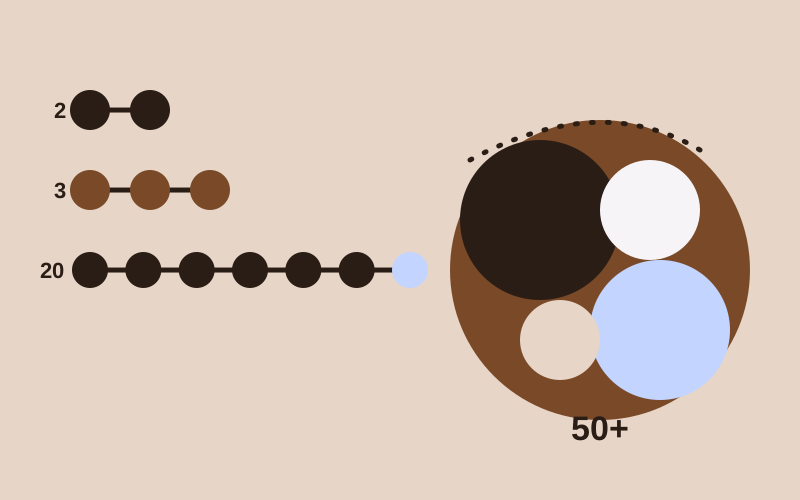
| 2 amino acids | dipeptide |
| 3 amino acids | tripeptide |
| 4 to about 20 | oligopeptide |
| About 20 to 50 | polypeptide / large peptide |
| Beyond about 50 | protein |
Notice the word about. No law of chemistry draws the line. Insulin has 51 amino acids and is called a protein hormone in some textbooks and a peptide hormone in others. Both labels are accepted, and nobody is wrong.
Why shape matters more than the label
A short chain is usually floppy. It wiggles in water and has no fixed shape. A long chain folds into a stable three-dimensional structure held together by many small attractions. That fold is what lets an enzyme grab a substrate or an antibody lock onto a virus.
Small peptides can still be rigid. Add a ring, a few disulfide bridges or unusual amino acids and a nine-residue chain can hold a precise shape. That is one reason chemists find them interesting as drugs.
Why the distinction has practical consequences
- Digestion: both are broken into smaller pieces in the gut, so swallowing a peptide rarely delivers it intact. See Why Most Peptides Can't Be Swallowed.
- Manufacturing: short peptides can be assembled chemically in a lab. Long proteins are normally produced by living cells.
- Regulation: in the United States, the FDA treats chains above 40 amino acids as proteins, and shorter ones as peptides. This is an administrative cutoff, not a biological one.
A useful mental model: a peptide is a short sentence, a protein is a whole paragraph that has been folded into a paper crane.
Key takeaways
- Peptide versus protein is mainly about length, with a fuzzy boundary around 40 to 50 amino acids.
- Folding makes proteins specific. Chemistry (rings, bridges) can give peptides structure too.
- Whenever someone says "peptides are natural, so they are safe", remember that natural does not mean harmless and does not mean it survives digestion.
Educational only. Not medical advice. Read the disclaimer.