Rings, Staples and Fat Tails: How Chemists Armor a Peptide
Natural peptides are fragile. A short tour of the tricks that make them last: cyclization, stapling, mirror-image amino acids and fatty-acid tags.
The fragility problem
A peptide in the blood is exposed to enzymes that cut chains, kidneys that filter small molecules out within minutes, and cells that may not let it in. Medicinal chemists have a toolkit for each problem.
Tool 1: close the ring
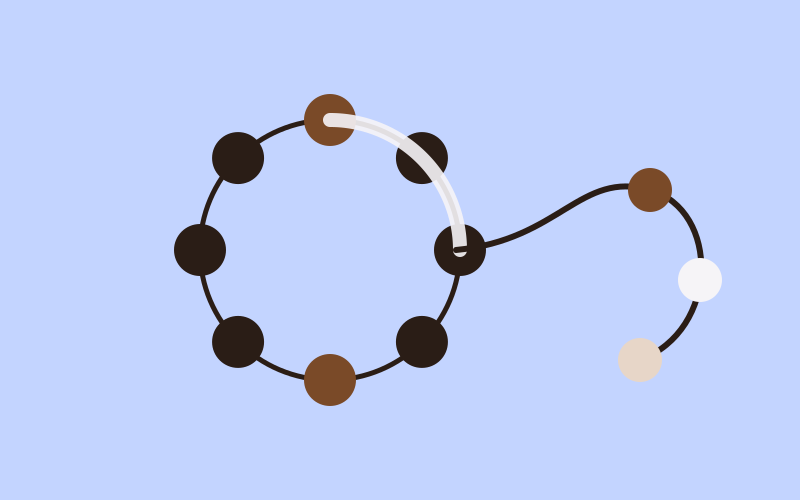
Linking the two ends of the chain, or two side chains, makes a cyclic peptide. Rings are harder for enzymes to grip and can hold a fixed shape. Cyclosporine, used to prevent organ rejection, is a natural cyclic peptide. Octreotide, a short ring built around a disulfide bridge, imitates the hormone somatostatin.
Tool 2: staple it
Many peptides form a helix when binding a target but unravel on their own. A hydrocarbon staple is a short chemical brace added across the helix to hold it in shape. Stapled peptides are still mostly in research, with a handful in clinical trials.
Tool 3: swap in mirror images
Replacing an L-amino acid with its D-form makes the bond unrecognizable to many enzymes. Chemists also add a methyl group to a backbone nitrogen (N-methylation), which blocks cutting and can improve membrane passage.
Tool 4: attach a fat tail
Lipidation attaches a fatty acid. In the blood, the tail binds albumin, a large carrier protein. A drug bound to albumin is shielded from enzymes and kidneys. This is how several once-weekly medicines achieve their long action.
Tool 5: change the size
Adding polyethylene glycol (PEGylation) or fusing the peptide to a carrier protein makes the molecule bigger so the kidneys retain it.
What you should not expect
Every modification is a trade-off. Armor can lower the potency, change which receptor is hit or create new side effects. Each engineered molecule must be tested as a new drug, which is precisely why you cannot infer safety of a modified peptide from the original.
Key takeaways
- Rings, staples, D-amino acids, fat tails and PEG each solve a specific weakness.
- Every change creates a new molecule that needs its own safety data.
- Longer action is engineered, never automatic.
Educational only. Not medical advice. Read the disclaimer.